
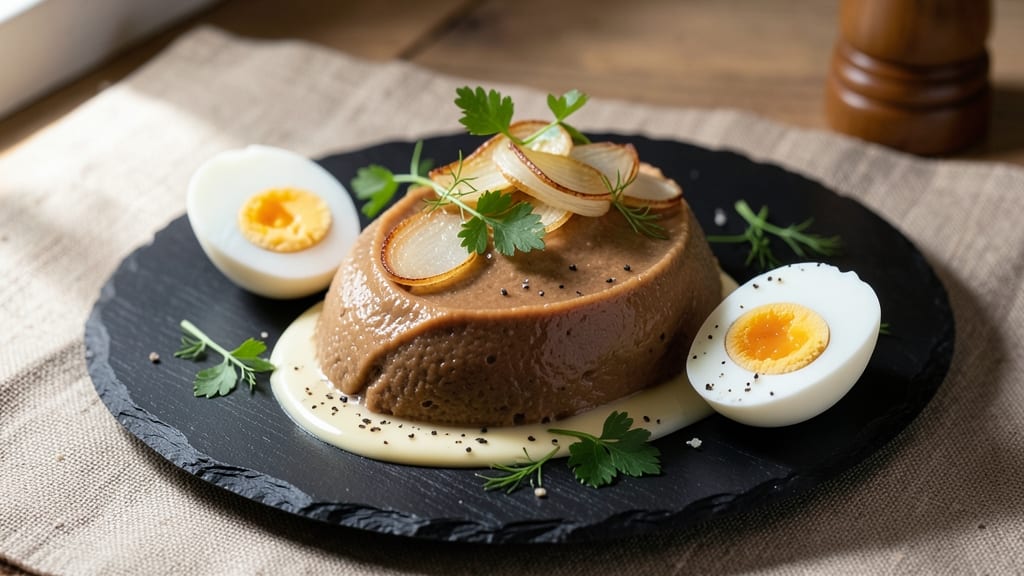
This chicken liver pâté with hard-boiled eggs delivers the rich, silky texture French cuisine is famous for—perfect for elevating brunch or holiday appetizers. 💛 The secret lies in purifying the livers and emulsifying them with egg yolks, creating a velvety spread that’s both elegant and deeply flavorful.
I first mastered this technique during my apprenticeship under Chef Chen, where we spent hours perfecting the balance between liver’s natural richness and the bright acidity of hard-boiled eggs.
The process begins with carefully purifying the livers to remove any bitterness, then rendering their fat to create a luxurious base. What makes this recipe special is the optional baking step—whether you prefer a firm terrine or a spreadable pâté depends entirely on your patience.
The hard-boiled eggs add both visual contrast and a subtle creaminess that cuts through the pâté’s intensity, making each bite perfectly balanced.
By the time you’re done, you’ll have a pâté that’s smooth as silk and packed with umami depth, ready to be served with crusty bread or elegant crackers. The eggs can be sliced into delicate garnishes or gently folded into the mixture for extra texture.
This is the kind of dish that transforms a simple gathering into something memorable—without sacrificing the comfort of home cooking.
Pair it with a bold red wine or crisp champagne to complement the pâté’s luxurious texture. The key is letting it rest overnight, allowing flavors to meld and the texture to become truly exceptional. Here’s how to make it—step by step, just like we do in professional kitchens.
Ingredients for chicken liver pate recipe with hard boiled eggs
French elegance meets rich umami in this luxurious pâté—just nine ingredients transform simple livers into velvety perfection.
| Ingredient | Amount | Notes |
|---|---|---|
| Fresh Chicken Livers 🍗 | 1 ½ lb | Purified and trimmed of connective tissue |
| Large Eggs 🥚 | 6 whole | Hard-boiled for garnish and texture |
| Unsalted Butter 🧈 | ¾ cup | Cold, cut into small cubes |
| Shallots 🧅 | 4 whole | Minced for aromatic depth |
| Fresh Parsley 🌿 | ¼ cup | Finely chopped, stems removed |
| Fresh Tarragon 🌿 | 2 tbsp | Chopped, for herbal brightness |
| Fresh Thyme 🌿 | 1 tbsp | Leaves only, finely chopped |
| Cognac or Brandy 🍷 | ½ cup | For deglazing and depth |
| Heavy Cream 🥛 | ½ cup | Cold, for emulsification |
| Diamond Crystal Kosher Salt 🧂 | 1 ½ tsp | For seasoning and curing |
| Freshly Ground Black Pepper 🌶️ | ½ tsp | For subtle heat balance |
| Extra-Virgin Olive Oil 🫒 | 2 tbsp | For finishing and richness |
| Crusty Baguette Slices 🍞 | 8 pieces | For serving and texture contrast |
| Lemon Zest 🍋 | 1 tsp | Brightens the final texture |
The livers are the heart of this dish, so purchase them fresh from a trusted butcher—they should be bright red, not brown or slimy. Costco’s pre-packaged livers work well, but if you’re feeling ambitious, ask for the freshest cut. Purifying them removes bitterness—soak in cold water for 10 minutes, then rinse thoroughly. The eggs need to be large, organic eggs for the best texture; Trader Joe’s carries them at a great price. For the herbs, fresh is non-negotiable—dried won’t give you that bright, aromatic punch. If you can’t find tarragon, substitute with half the amount of fresh dill, though it won’t be identical.
No cognac? Dry sherry or apple cider works in a pinch, though cognac adds that signature depth. The heavy cream is crucial for emulsification—full-fat only, no skim. For a lighter version, replace half with Greek yogurt, but texture will differ. The butter should be cold and cubed when added; don’t let it melt prematurely. If you’re making this ahead, the pâté actually improves overnight—cover with plastic wrap pressed directly on the surface to prevent a skin from forming. The crusty baguette? Day-old works best—it’s sturdier for serving.
This pâté keeps beautifully in the fridge for 5-7 days, though it’s best within the first 48 hours. For longer storage, freeze in an airtight container for up to 3 months. Let it come to room temperature before serving—never microwave, as it can break the emulsion. Garnish with lemon zest just before serving to keep it vibrant. The hard-boiled eggs can be peeled and sliced into delicate rounds for a stunning presentation, or gently folded into the pâté for extra creaminess. Serve with a bold red wine like Cabernet Sauvignon or a crisp sparkling wine to cut through the richness.
Why You’ll Love This Recipe
- No-Fuss Assembly: I swear by this recipe because it’s basically hands-off after the initial chop. Sauté the livers and shallots in butter until they’re golden—no stirring every two seconds, no watching like a hawk. The eggs just sit in the simmering water while you focus on the pate, then get chopped in and blended. That’s it. Minimal steps, maximum flavor.
- Rich, Earthy Depth: Between the livers’ natural richness and the buttery shallots, this pate has a depth that’s hard to beat. The hard-boiled eggs add a creamy contrast that cuts through the intensity—like a velvet glove over a velvet fist. Honestly, I’ve made it for people who “don’t like liver,” and they’ve come back for seconds.
- Party-Ready in Minutes: This is my secret weapon for gatherings where you want to impress without slaving away. Spread it on crusty bread for a charcuterie board, dollop it on crackers with a sprinkle of parsley, or serve it with toasted baguette slices. It’s fancy enough for a dinner party but unfussy enough for a lazy Sunday. (Yes, even on a Tuesday night.)
- Budget-Friendly Luxury: Chicken livers are one of those ingredients that feel indulgent but won’t break the bank. A pound goes a long way, and the eggs stretch it further. Plus, leftovers? They keep beautifully in the fridge for days—perfect for quick lunches or last-minute appetizers. It’s the kind of dish that makes you feel like you’re eating well without overspending.
Step-by-step instructions for chicken liver pâté with hard-boiled eggs
Here’s how to create a velvety, restaurant-worthy pâté that balances rich liver flavor with bright herbal notes.
👨🍳 Step 1: Purify and Sear the Chicken Livers
Rinse the 1.5 lb fresh chicken livers under cold water and pat them completely dry with paper towels. This is crucial—any moisture will prevent proper searing. In a large skillet, heat 1 tablespoon of the extra-virgin olive oil over medium-high heat until shimmering.
Add the livers in a single layer and cook for 2-3 minutes per side until they develop a deep brown crust. You’ll see them release easily when done—don’t overcook or they’ll turn rubbery. Transfer the seared livers to a cutting board and let them rest for 5 minutes before purifying.
Using a sharp knife, carefully trim away any connective tissue or silver skin from the livers. This step ensures your pâté will be silky smooth. Chop the purified livers into ¼-inch pieces and set aside in a bowl.
🍳 Step 2: Sauté Aromatics and Deglaze with Cognac
In the same skillet (no need to clean it—the browned bits add flavor), add the remaining 1 tablespoon extra-virgin olive oil and 4 whole minced shallots. Cook over medium heat for 5-6 minutes until the shallots are translucent and just beginning to turn golden.
Add the 2 tablespoons chopped fresh tarragon and 1 tablespoon chopped fresh thyme, stirring for 30 seconds until fragrant. Pour in the ½ cup cognac or brandy and immediately scrape up all the browned bits from the bottom of the pan. Let it simmer for 2-3 minutes until reduced by half.
Remove the skillet from heat and let it cool slightly. This aromatic base will form the flavor foundation of your pâté.
🥘 Step 3: Create the Pâté Base with Eggs and Butter
In a food processor fitted with the metal blade, combine the chopped livers, shallot mixture, 6 whole hard-boiled eggs (peeled and roughly chopped), 0.75 cup cold unsalted butter (cut into cubes), 0.5 cup cold heavy cream, 1.5 teaspoons kosher salt, and 0.5 teaspoon black pepper.
Pulse the mixture until it reaches a smooth, paste-like consistency—about 3-4 minutes of processing. Scrape down the sides as needed. The texture should be thick but still spreadable. If it’s too dry, add 1 tablespoon cold heavy cream at a time until you achieve the perfect consistency.
Transfer the pâté mixture to a heatproof bowl and place it over a pot of barely simmering water (bain-marie). Cook gently for 10-12 minutes, stirring occasionally with a silicone spatula, until it reaches 160°F internally. This gentle heating ensures the eggs cook safely while keeping the texture silky.
🍽️ Step 4: Finish and Serve with Herbs and Zest
Remove the bowl from the heat and stir in the 0.25 cup finely chopped fresh parsley and 1 teaspoon lemon zest. The parsley adds freshness while the lemon zest brightens the rich flavors. Taste and adjust seasoning if needed—you might want to add a pinch more salt or pepper to balance the flavors.
Transfer the pâté to a serving dish and smooth the top with a spatula. Chill in the refrigerator for at least 2 hours (or up to 24 hours) to allow the flavors to meld completely. When ready to serve, garnish with additional chopped herbs if desired.
Serve the pâté at room temperature with 8 pieces crusty baguette slices for dipping. The contrast between the rich pâté and the crisp bread creates the perfect bite. This elegant preparation makes an impressive appetizer or light lunch that showcases the luxurious combination of chicken liver and hard-boiled eggs.
Pro Tips For Making Chicken Liver Pate Recipe With Hard Boiled Eggs
- Trim and Soak Livers: Chicken livers hold blood and bitterness—trim off any greenish connective tissue and soak them in cold milk or lemon water for 10 minutes. I learned this the hard way after serving a batch that tasted metallic; the soak makes a real difference.
- Cook Livers Fast: Use a screaming-hot pan and keep heat high until they’re just done—about 2-3 minutes per side. Overcooking turns them rubbery, and no one wants that in pâté. Sear them first, then finish gently.
- Peel Eggs Right: Shock eggs in ice water, then roll them under your palm to crack the shell before peeling. This isn’t the prettiest method, but it works every time—no stubborn bits left on the whites.
- Blend in Stages: Pulse the livers and eggs in batches with the butter to avoid a greasy mess. Start with half the butter, then add more as you blend—this keeps the texture smooth without turning it into soup.
Storing and reheating this recipe
Refrigerator Storage
Your freshly made pâté tastes best within 48 hours when stored in the refrigerator, but it will keep for up to 5-7 days in an airtight container. I use glass containers with snap-on lids to prevent any off-flavors from seeping in.
Press plastic wrap directly onto the surface before sealing to maintain that velvety texture—this prevents a skin from forming. 💛 The hard-boiled eggs can be stored separately in their shells (peeled or unpeeled) for up to 1 week in the fridge.
Freezer Preservation
For longer storage, freeze the pâté in a single layer in a freezer-safe container, leaving 1 inch of headspace for expansion. It will keep for up to 3 months without losing texture or flavor.
Thaw overnight in the refrigerator—never at room temperature—to preserve the emulsion. The eggs can also be frozen in their shells for up to 3 months, though texture may soften slightly when reheated.
Reheating Safely
This pâté is best served cold or at room temperature, but if you need to reheat, do so gently. Place the pâté in a heatproof bowl and set it over a pot of barely simmering water (bain-marie) for 5-7 minutes, stirring occasionally.
Never microwave—it can break the emulsion and make the texture grainy. If reheating, add a splash of cold heavy cream to restore smoothness. The eggs can be reheated in warm water for 10 minutes if needed.
Room Temperature Service
Always bring your pâté to room temperature before serving—this enhances the flavors and creates the perfect spreadable consistency. Remove it from the fridge 1 hour before serving. The hard-boiled eggs should also be at room temperature, so peel and slice them just before plating.
Serve with chilled crusty baguette slices or water crackers for the best experience. The contrast of warm pâté with cool bread is pure magic. ✨
Garnish Refreshment
Fresh garnishes make all the difference when serving. Just before plating, add a sprinkle of lemon zest and chopped parsley to brighten the flavors. For extra elegance, slice the hard-boiled eggs into delicate rounds and arrange them on top.
A drizzle of extra-virgin olive oil or a pinch of fleur de sel can elevate the presentation to restaurant-quality. Trust me, these little details transform a homemade dish into something truly special.
Nutrition facts
Frequently asked questions
Why do I need to purify the chicken livers before making pâté?
Purifying removes the bitter gall bladder and connective tissue that can make your pâté taste unpleasant. Simply rinse the livers in cold water, then trim away any visible silver skin or connective tissue using a sharp knife. This step is crucial for achieving that silky, luxurious texture we all love in French pâtés.
Can I make this pâté without hard-boiled eggs?
The eggs add creaminess and visual appeal, but you can substitute with ¼ cup crème fraîche or 2 tablespoons Greek yogurt for a similar texture. For a richer version, try adding 2 ounces of cream cheese instead. Just remember to adjust the recipe’s overall moisture balance accordingly.
How do I know when the pâté is fully cooked?
Use a food thermometer to check the internal temperature—it should reach 160°F when gently heated in a bain-marie. The mixture will also thicken noticeably and pull away slightly from the sides of the bowl. If it’s too runny, let it cook longer; if it’s too thick, stir in 1 tablespoon cold heavy cream to restore smoothness.
What’s the best way to serve this pâté?
This pâté shines when served at room temperature with crusty baguette slices or water crackers. For an elegant presentation, arrange it on a platter with sliced hard-boiled eggs on top, drizzled with olive oil and sprinkled with fresh herbs. It’s also perfect for stuffing into mini phyllo cups or spreading on toasted rye bread for open-faced sandwiches.
Can I make this ahead of time?
This pâté actually tastes better after resting! Let it chill in the refrigerator for at least 2 hours (up to 24 hours) before serving. The flavors meld beautifully during this time, and the texture becomes even more velvety. Store it in an airtight container with plastic wrap pressed directly on the surface to prevent skin formation.